LocalPOS Pro
A multi-surface point-of-sale and business operations platform
A multi-surface point-of-sale and business operations platform exploring POS, kitchen display (KDS), self-order kiosk, ordering, and administrative workflows for a single store.
- Status
- In Development
- Category
- BUSINESS
- Year
- 2026
- Primary stack
- Next.jsTypeScriptSupabase
- Demo
- ENTER THE BUILD
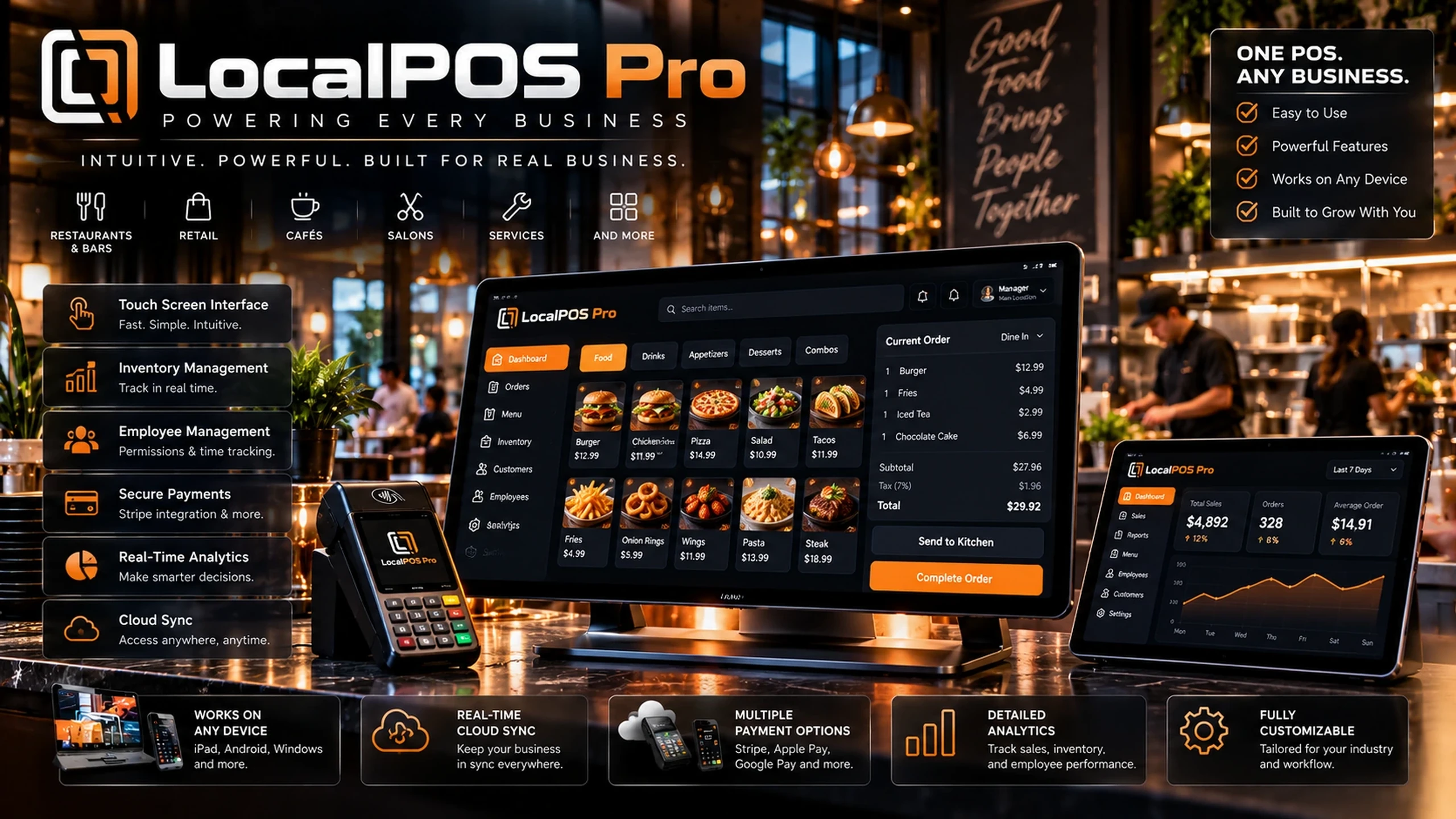
Project visualization — a designed representation, not a literal screenshot
01Overview
What this is
A multi-surface point-of-sale and business operations platform exploring POS, kitchen display (KDS), self-order kiosk, ordering, and administrative workflows for a single store.
Explores
- Point of sale
- Kitchen display system (KDS)
- Self-order kiosk
- Ordering
- Administration
- Store management
- Business configuration
- Supabase backend
- Backend services
- Automated testing
02Explore the build
The demo and the build insight
The demo
External application
ENTER THE BUILD
The public LocalPOS Pro build — POS, kitchen display, kiosk, and operations surfaces, live on Vercel.
ENTER THE BUILDBuild insight
- Current build
- In Development
- Architecture and features below are the real build.
- Demo
- External
- Launch control above opens the verified public build.
Build insight — real project data, not a live application.
One store-scoped data model is the single source of truth. Each surface is a tailored view over it, which keeps order state consistent when a kiosk order and a POS order interleave on the same kitchen screen.
03Problem · opportunity
What it sets out to solve
Running a local restaurant or retail business means juggling a fragile POS, a separate kitchen screen, an unconnected ordering channel, and admin work spread across still more tools. Small operators need one coherent system, not a stack of integrations.
04Concept
The core idea
A single business operations platform where the register, kitchen, kiosk, and back office all read from the same live store state — orders, menu, staff, and settings — instead of each surface maintaining its own copy of reality.
05What I built
What's actually in the code
In-progress development. The store data model, backend services, and first surfaces are being built against Supabase, with automated tests covering business logic as it stabilizes.
Approach
Defining one store-scoped data model (menu, orders, tables, kitchen stations, staff) on Supabase, then building each surface — POS, KDS, kiosk, ordering, admin — as a view over that model. Backend services and automated tests are part of the build rather than an afterthought.
06Key features
What's implemented today
- Shared store state across POS, kitchen, kiosk, and admin surfaces
- Menu and business configuration owned by the store, applied everywhere
- KDS routed from the same order stream as the register
- Kiosk and ordering flows modeled on the same catalog
- Backend services built over Supabase for the core order lifecycle
- Automated tests on business logic as it stabilizes
07Architecture
How it's structured
One store-scoped data model is the single source of truth. Each surface is a tailored view over it, which keeps order state consistent when a kiosk order and a POS order interleave on the same kitchen screen.
Design notes
The design is pragmatic: local business is the scope, multi-store growth is out of scope for now. Offline tolerance and hardware (printers, displays) are anticipated but not yet implemented.
08Technology
The stack
- Next.js
- TypeScript
- Supabase
- PostgreSQL
- Node.js
- Tailwind CSS
09Challenges · lessons
Where it got hard, and what it taught me
Challenges
- Keeping order state consistent across surfaces updating the same store in parallel
- Defining which configuration belongs to the store vs. the platform
- Resisting scope creep into multi-store enterprise territory
Learnings
- A shared data model removes an entire class of sync bugs before they exist
- Self-ordering surfaces are only trustworthy if the kitchen view of an order is authoritative
- Testing business logic early is cheap relative to debugging live order flows
10Current status
Where this project sits today
Architecture is established and modules are actively being built. Parts exist; the whole is not finished.
Demonstrated
- Store data model and backend services in active development on Supabase
- Automated tests being written for core business logic
11What comes next
Where this goes from here
- 01Complete the order lifecycle end to end across POS and KDS
- 02Add the kiosk and ordering surfaces against the shared catalog
- 03Expand automated test coverage across backend services