Smart Warehouse
A connected warehouse operations ecosystem — VWMS / NEXUS
A connected warehouse operations ecosystem exploring inventory management, warehouse design, 2D planning, 3D spatial visualization, operational dashboards, AI assistance, and physical-world system concepts.
- Status
- In Development
- Category
- BUSINESS
- Year
- 2025
- Primary stack
- Next.jsTypeScriptSupabase
- Demo
- ENTER THE BUILD
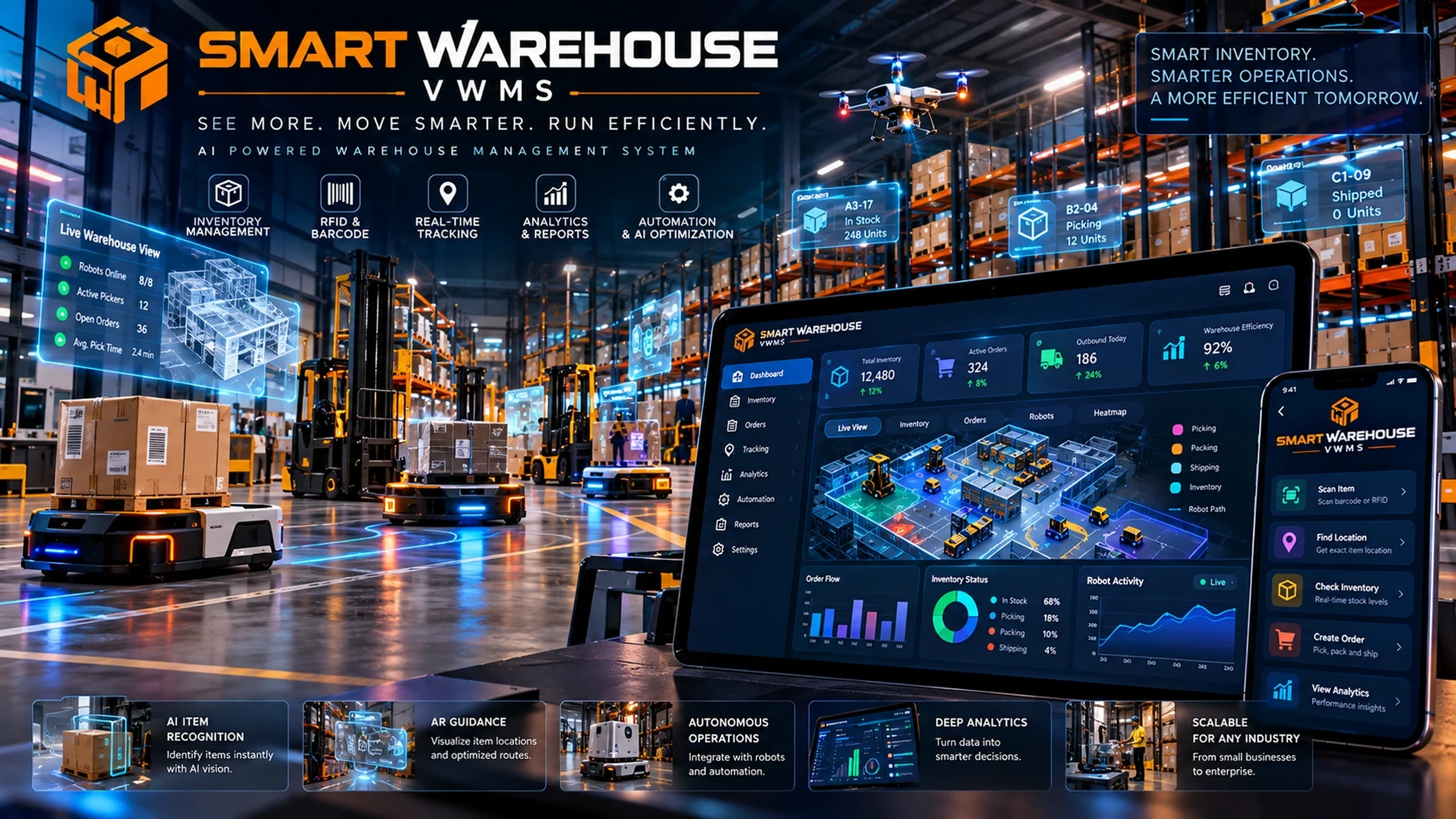
Project visualization — a designed representation, not a literal screenshot
Additional view
Inside the build
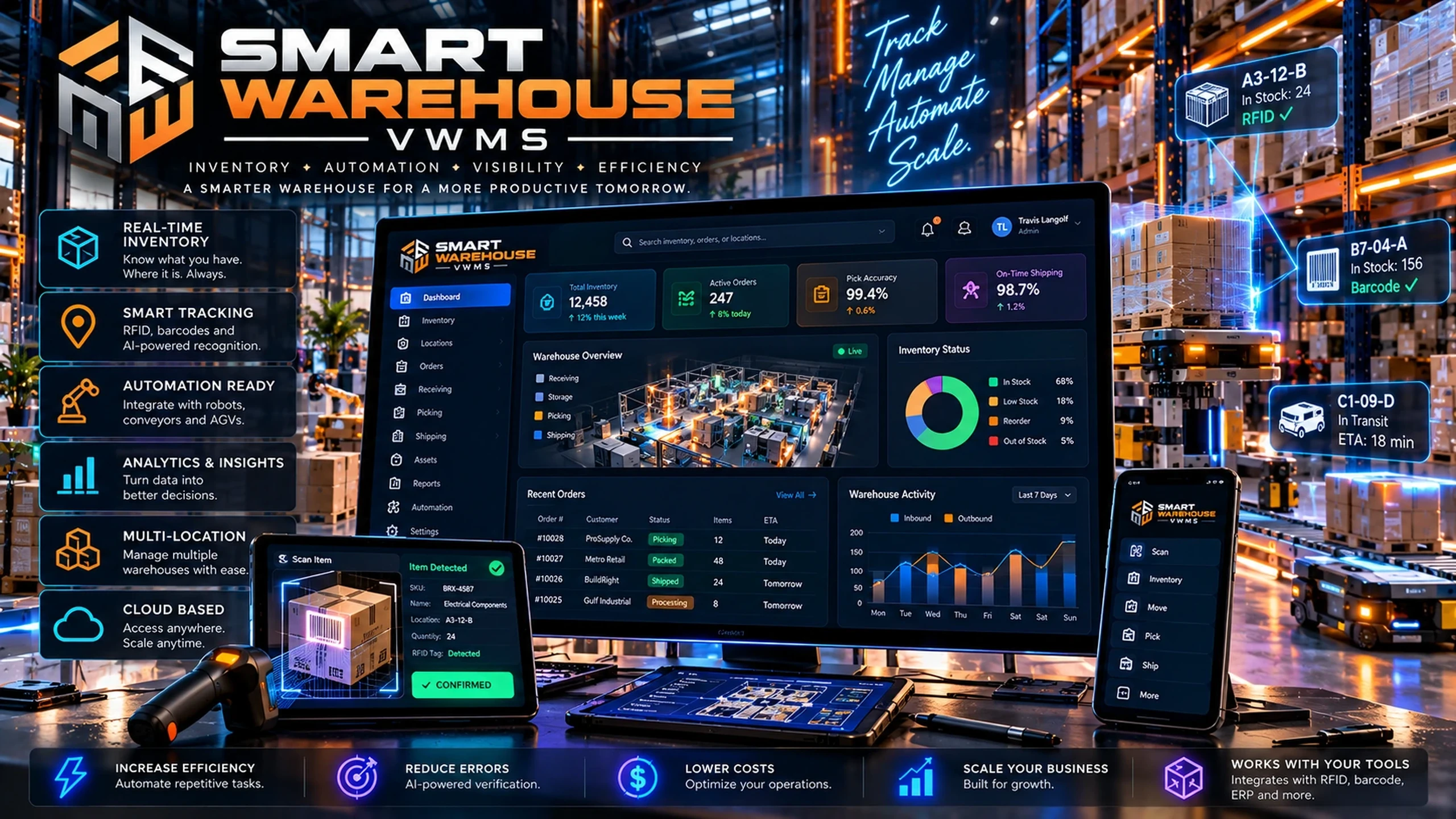
VWMS operations surface
A companion visualization for the live Virtual Warehouse Management System experience.
01Overview
What this is
A connected warehouse operations ecosystem exploring inventory management, warehouse design, 2D planning, 3D spatial visualization, operational dashboards, AI assistance, and physical-world system concepts.
Explores
- Warehouse management
- Inventory tracking
- Warehouse design
- 2D planning
- 3D warehouse visualization
- Operational dashboards
- AI assistance
- Automation
- Real-time systems
- Device / hardware concepts
- Supabase backend
- Testing
02Explore the build
The demo and the build insight
The demo
External application
ENTER THE BUILD
Smart Warehouse / VWMS — the Virtual Warehouse Management System as a live deployed experience.
ENTER THE BUILDRelated in this ecosystem
- Explore Inventory
Inventory Management
A related deployed experience within the Smart Warehouse / NEXUS ecosystem.
Build insight
- Current build
- In Development
- Architecture and features below are the real build.
- Demo
- External
- Launch control above opens the verified public build.
Build insight — real project data, not a live application.
The design treats every module as a view over one shared data model rather than a separate product. Layout definitions, inventory, and operational events all live in the same backend, which is what makes 2D planning, 3D visualization, and dashboards consistent with each other.
03Problem · opportunity
What it sets out to solve
Small and mid-sized warehouses juggle spreadsheets, siloed tools, and manual processes. Any of them know what is on the floor, but almost none have a live, spatial, connected view of the operation.
04Concept
The core idea
Treat the warehouse as one connected environment: a single system that moves inventory through operational workflows, lets operators design and visualize the facility in 2D and 3D, and surfaces AI assistance and automation without pretending the physical world is optional.
05What I built
What's actually in the code
In-progress development. A shared data foundation and the first operational modules are being built, with the 2D planning and 3D visualization views architected as connected modules rather than standalone products. Stripe architecture design exists for a future subscription layer.
Approach
Building the ecosystem as layered modules over a shared Supabase backend: inventory and operations first, then a 2D design/planning layer, a 3D spatial visualization view, dashboarding, and progressively an AI assistant and automation layer.
06Key features
What's implemented today
- Shared inventory and operational data model across every module
- Facility design and 2D planning views being built against the same data store
- 3D visualization layer architected so the warehouse layout renders from real layout data, not placeholder scenes
- Operational dashboards for stock levels and activity
- AI assistance planned as an interface over the structured operational data
- Stripe billing architecture drafted for a future paid tier
07Architecture
How it's structured
The design treats every module as a view over one shared data model rather than a separate product. Layout definitions, inventory, and operational events all live in the same backend, which is what makes 2D planning, 3D visualization, and dashboards consistent with each other.
Design notes
The project is deliberately structured as a family of modules. A future physical-device layer (scanners, sensors) is designed around the same event model so hardware integration does not require reshaping the data core.
08Technology
The stack
- Next.js
- TypeScript
- Supabase
- PostgreSQL
- Tailwind CSS
- Three.js (planned)
- Stripe (planned)
09Challenges · lessons
Where it got hard, and what it taught me
Challenges
- Keeping a layout model that is rich enough for 2D planning and honest enough to render credibly in 3D
- Deciding when automation should be real versus simulated without overstating capability
- Designing billing/Stripe architecture before the product is proven
Learnings
- A module-over-monolith data design makes a broad ecosystem much easier to reason about
- Spatial visualization is only valuable when it reflects the same data operators actually use
- Clear boundaries between built, being built, and planned keep development honest
10Current status
Where this project sits today
Architecture is established and modules are actively being built. Parts exist; the whole is not finished.
Demonstrated
- Shared Supabase data model and first operational modules under active development
- Billing architecture documented as a Stripe integration design
11What comes next
Where this goes from here
- 01Complete the inventory and operations modules end to end
- 02Ship the 2D planning view wired to the real layout data
- 03Connect the 3D visualization to the layout model
- 04Decide the scope of the AI assistant against the structured data surface